01 / open to all
The Door
Public media: cases, frameworks, disagreements, decisions and lessons. It earns attention without requiring attendance.
Promise: “I leave with a better way to think.”
Make product thinking visible and useful. Build a brand people can learn from anywhere, and a room where selected operators can do the work together.
Working sessions are the flagship, not the whole company. The content must be useful even to someone who never applies for a seat. The room gives the brand its depth; public work gives it reach.
Identity constraints: Product Garage, never “The Product Garage” in public; Oil Black #171512 and Workshop Chalk #F3EEE5; Melodrama for display, Switzer for utility; Irish English; no em-dashes or piled-up fragment copy.
Business and offer: working sessions are the flagship; premium must mean both an excellent room and excellent work; the October room has 12 participants; “Apply for a Seat” is the primary operator recruitment CTA.
Ambition: the brand has a substantial public media side, a 90-day content plan, and a long-term 1M-follower ambition. Follower count is an ambition, not proof of usefulness.
Organising idea: “Open the garage door.” An internal creative device for revealing how decisions get made, not a public tagline or a claim that every post needs a shutter graphic.
Working positioning, not yet customer-validated: Product Garage is a product thinking network and media brand for builders and companies who need sharper product and go-to-market decisions. It publishes useful thinking openly and runs selective working sessions where real challenges are examined with experienced operators.
Public media: cases, frameworks, disagreements, decisions and lessons. It earns attention without requiring attendance.
Email and WhatsApp provide a durable relationship, specific discussion and a path back to the work. This is not a dumping ground for event announcements.
Flagship working sessions place a suitable live challenge before prepared operators. Quality is judged by the decisions, not how photogenic the room looks.
A bounded, decision-worthy challenge and the facts needed to examine it.
Operators expose assumptions, options and trade-offs rather than simply vote.
A facilitator and evidence bar protect the quality of the thinking.
Recognisable language, behaviour and visual cues make the brand easy to recall.
Decision records, follow-ups and useful media show what actually happened.
Loop: evidence improves the next challenge, the next public explanation and the next brand decision. If an element produces no observable output, it is theatre.
These are three different kinds of input. Mixing them would make the strategy look more certain than it is.
Flagship sessions, 12 October participants, core palette and typography, one recruitment CTA, a public media ambition. A brand book must implement these, not silently reopen them.
Public first-session accounts describe a real B2B challenge, an awkward start, assumptions being challenged and visible thinking. The October listing describes another live challenge. These are first-party reports, not independent evidence of business outcomes.
That people will choose Product Garage over conferences, courses, peer groups, agencies or general product content because of unusually concrete, candid decision work.
Ask what the audience would actually do instead: consume free content, attend a conference, join a peer group, hire help or work alone.
List only capabilities we can deliver repeatedly: live challenge selection, preparation, facilitation, decision record, follow-up and candid publishing.
Translate a capability into a buyer benefit, then ask for evidence. “Documented trade-offs” may improve a decision; the improved decision is not yet proven.
Find the people who feel this value most acutely. Interview founders and operators separately. Exclude audiences looking only for generic networking.
Choose language that helps the right person understand the offer quickly. Test “product thinking network” against “working-session community” and “product/GTM media brand.”
This sequence follows April Dunford’s positioning method. The table below is a hypothesis map for interviews, not invented customer research.
| Audience | Actual alternatives to test | Candidate value | Evidence needed |
|---|---|---|---|
| Founder / company | Internal meeting; agency or consultant; customer research; doing nothing | A sharper decision with credible outside challenge and a documented next step | Interview; accepted challenge criteria; founder action 30 days later |
| Operator | Meetup; conference; paid community; online discussion; private peer circle | Meaningful practice with serious peers and a real company problem | Motivation interview; attendance, contribution and return behaviour |
| Public follower | Creator feed; newsletter; podcast; course; scrolling past | A useful, memorable way to reason through product and GTM decisions | Comprehension test; saves, return use, qualified subscriber growth |
The insight we are testing: Most product content shows opinions and outcomes. Product Garage can earn distinctiveness by showing the route from messy problem to defensible decision. This is an inference from the current offer and public examples, not a discovered universal truth. Disconfirm it if target people do not notice, value or remember the difference.
All three retain the settled palette and type direction. They explore expression, not a new identity. These are generated concept images, never representations of a real Product Garage session or participant.
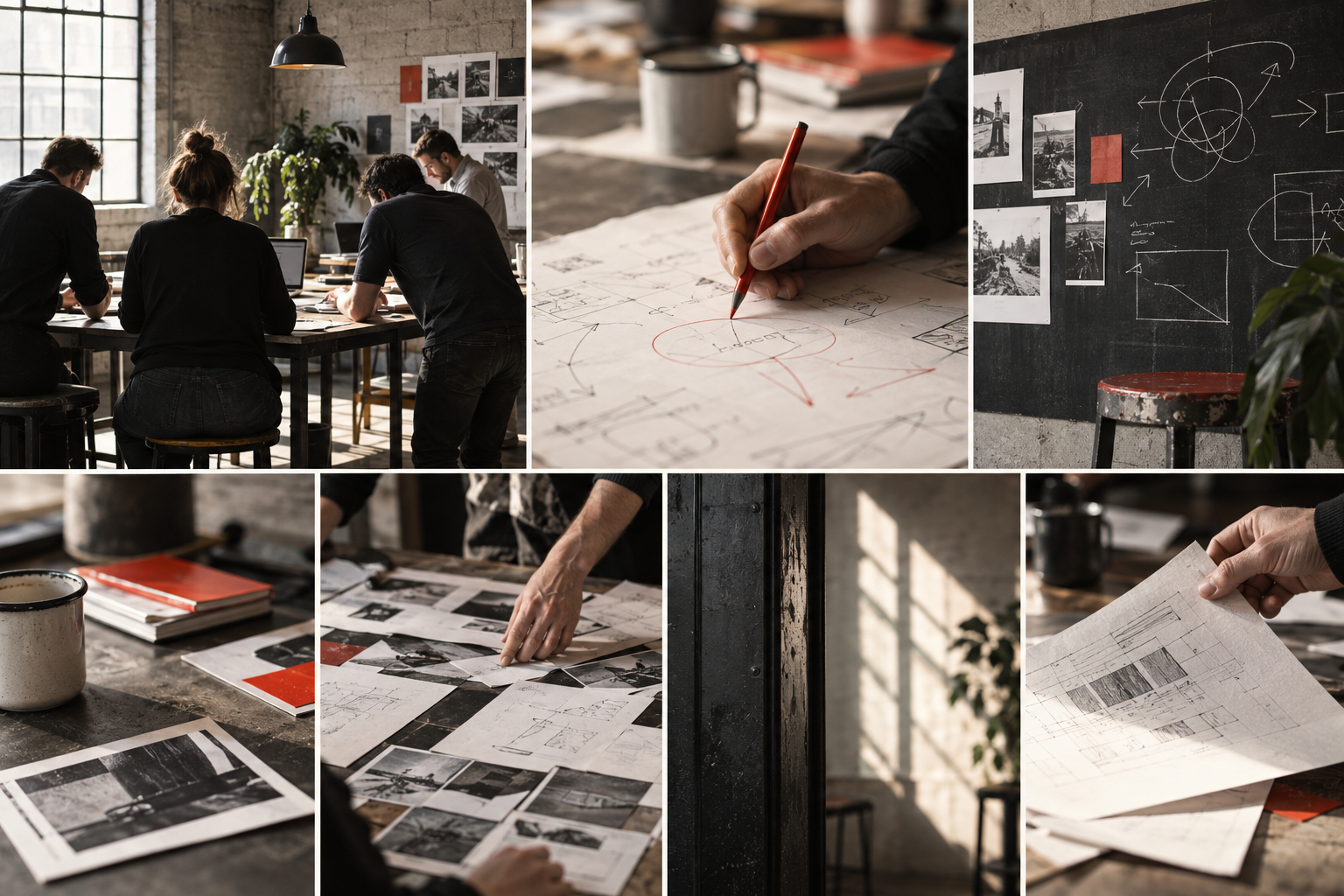
A / Workshop Documentary · AI-generated concept imagery
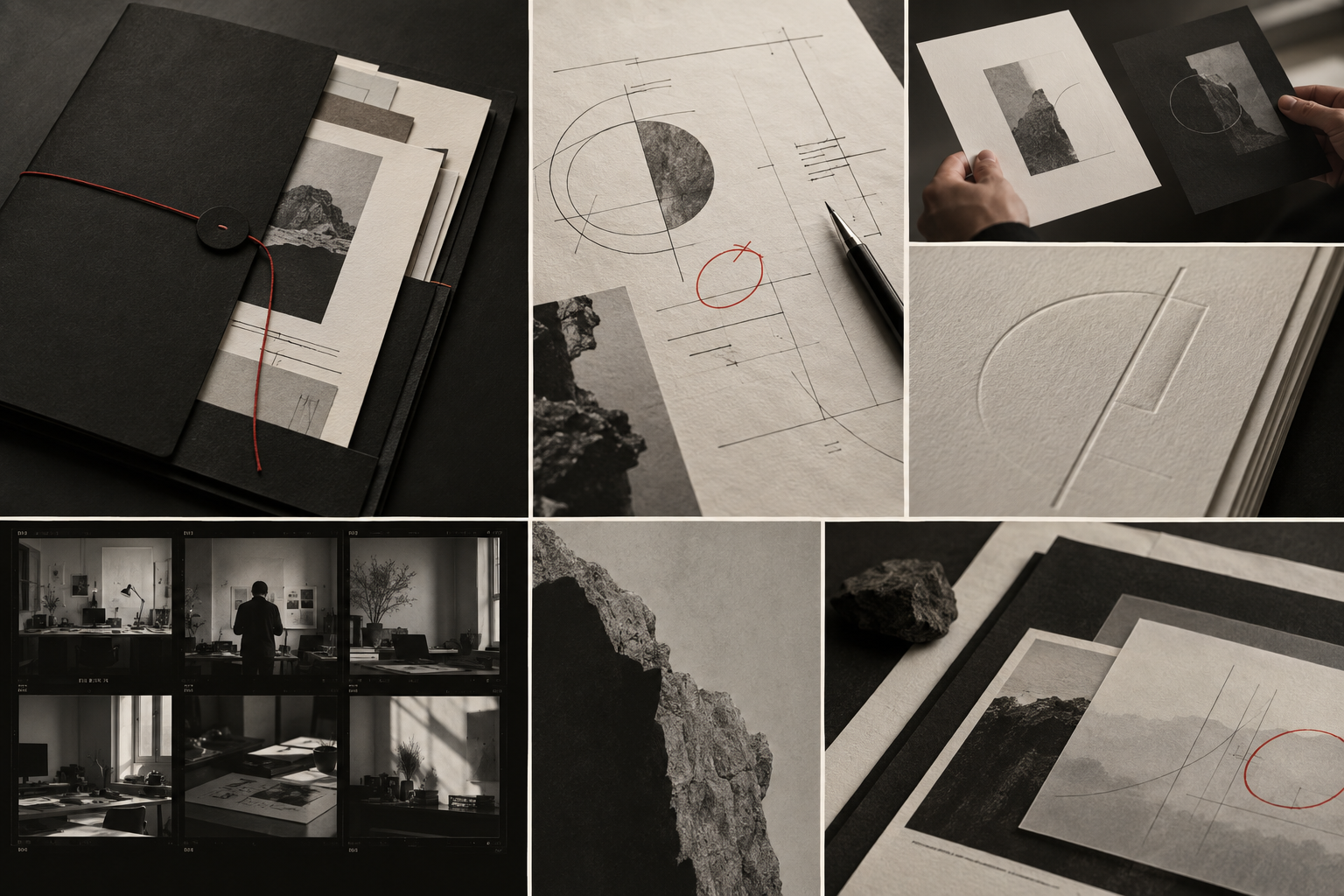
B / Editorial Casebook · AI-generated concept imagery
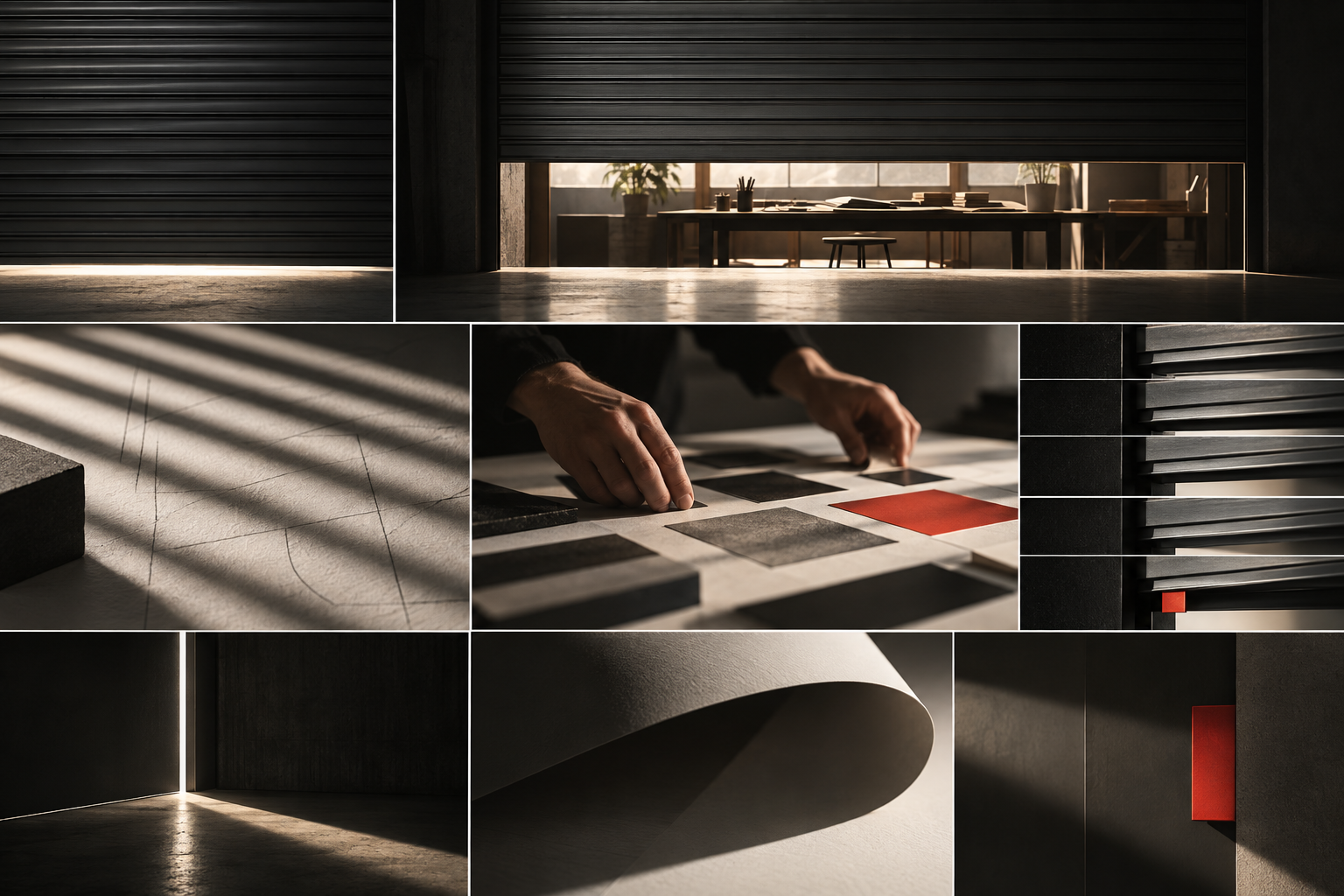
C / Shutter Signal · AI-generated concept imagery
Show actual human work; package it in a distinctive editorial case format; reserve the door/shutter for a reveal. This is a design recommendation, not an audience-tested fact.
Premium is earned through the quality of thinking and the restraint of its presentation. The design system should make a decision easier to see, not make a room look exclusive for its own sake.
Oil/Chalk contrast is 15.77:1. Signal Red on Chalk is 4.16:1 and on Oil is 3.79:1, so do not use it for small body copy. Use Deep Signal #A82A18 on Chalk for smaller accent text, or Chalk/Oil for readable labels. Check every final composition.
Use for expressive headlines and large editorial statements. Keep the words plain. The type carries the character.
Use for body, navigation, captions, forms and diagrams. Test with the licensed font files before final release; this page falls back if Melodrama is unavailable.
Audience-first, specific and calm. Irish English. Use full sentences when the thought requires them. Avoid em-dashes, artificial urgency, vague prestige and dramatic fragment stacks.
Ribs, the red signal and the Garage mark are designed cues, not proven distinctive assets. Repeat them consistently, then test whether target people recognise Product Garage without seeing the name.
A useful case starts where the options became uncomfortable.
Product GarageSocial case card: public value comes before promotion.
The evidence mattered more than the loudest opinion.
Product GarageVideo cover: replace concept image with approved real footage.
Prepared operators. A real challenge. A decision worth making.
Apply for a SeatOperator recruitment page: one primary CTA.
These are layout directions, not approved final copy or photographed proof. Founder-facing and media pages may use different task-appropriate actions; the single-CTA rule applies within a page, especially operator recruitment.
A selective application and polished footage cannot compensate for a weak challenge. The session needs a repeatable operating standard that produces a useful decision record even when the answer remains uncertain.
It has a decision owner, a bounded question, viable options, relevant facts, permission to discuss, and willingness to act on an answer.
Two to four pages: business context, precise decision, what is known, assumptions, constraints, candidate options and what input is most useful.
Question → facts → assumptions → options → trade-offs → recommendation → conditions that would change it.
State what was recommended, by whom, on what evidence, with dissent and unresolved questions. Separate private and public versions.
Did the founder adopt, adapt, reject or defer the recommendation? What changed, and what remains unknown?
October’s 12 participants are final. Do not turn that into an untested permanent format rule. Staff each session for facilitation, challenge ownership, participant experience and capture. If one person must do all four, reduce the scope of capture.
Plan filming before applications. Tell people what will be recorded and where it may appear; establish and document an appropriate lawful basis; offer workable camera-safe participation; mark restricted company information; review clips and quotes before publishing. Set access and retention rules for raw files. Have Irish counsel check the wording and process.
The Irish Data Protection Commission notes that identifiable event images can be personal data and advises particular care at small events. That guidance does not mean Product Garage cannot film; it means “cameras on by default” is not a complete policy. Read the DPC guidance.
A million followers is a reach ambition. The operating question is simpler: would a builder follow Product Garage even if they never enter the room? Every public piece should answer a live question, reveal a decision or improve a reader’s judgement.
Set up a real product or GTM decision. Show constraints and why the obvious answer is insufficient. A public question can be anonymised when necessary.
Make competing reasoning visible. Two credible operators may disagree. Edit for clarity without sanding away the trade-off.
Return to a decision after the session. State whether advice was used, modified, rejected or not yet tested. This is the highest-value proof series.
Teach a tool or question anyone can use. No attendance required, and no bait that withholds the actual insight behind an application.
Test the situations that make someone seek this brand: a product decision is stuck; a GTM launch has competing bets; a founder needs independent challenge; an operator wants serious practice. Use these situations in hooks, titles, search language and creator briefs.
Each session can produce a private record, an approved public case, short clips, a longer explanation and an email. Not every session will permit every asset. Build non-session series too, so publishing does not stall between rooms.
Choose two primary channels based on where target operators actually are. Produce three core formats. Record effort per asset and test comprehension, saves and qualified follows. Do not lock a daily cadence yet.
Keep formats people use and remember. Build capture, editing, approval and distribution templates. Add an owned email path. Archive weak formats instead of feeding every platform.
Set a sustainable weekly rhythm from actual production hours. Only expand channels when the core pipeline is reliable and the public content remains independently useful.
The existing 90-day LinkedIn calendar is a draft idea bank, not a ratified publishing schedule. The earlier multi-platform daily quota needs a team-capacity check.
Measure reach and usefulness separately. Track qualified reach, returning viewers, email subscribers and unaided brand recall alongside saves, replies from target people, decision-tool use and applications from suitable operators. Followers alone can reward spectacle.
Ogilvy’s insistence on tested communication, Neumeier’s experience-level view and Ehrenberg-Bass’s work on mental availability all point to a practical discipline: deliver the experience, prove it, make it easy to recognise and test whether people remember it.
“Twelve operators participated.” Use only when the register confirms it. Public counts must match the actual room.
Quote a participant with their approval and context. Praise is testimony, not an outcome measure.
Publish founder action only after a documented follow-up and permission. Adoption, rejection and delay are all legitimate data.
Revenue or product impact requires time, attribution and evidence. Do not leap from a good session to a business-result claim.
Founder rates whether the record clarified a choice and identifies the next action. Capture before publication.
Prepared attendance, meaningful contribution and willingness to return or refer.
Target-person saves, replies, repeat viewing and email conversion by content series.
Show assets without the name and ask which brand people recall. Test the shutter and red cue rather than assuming ownership.
Decision → alternatives considered → evidence → objection → owner → date → what would falsify it → next review. Use this for positioning, moodboard, red accent and content formats.
Marketing owns the book, room lead verifies experience claims, challenge owner approves sensitive material, editor checks copy and rights, and founder team ratifies strategic changes. Review monthly while the system is new.
This book is ready to direct work. These items are not excuses to pause the entire brand, but they do need owners before public claims, capture and asset rollout.
| Priority | Action | Why | Exit test |
|---|---|---|---|
| Now | Correct the October event listing that still says 16 in its prose; 12 is the final participant count. | Conflicting public numbers erode trust and complicate applications. | Every live listing, email and site says the same number. |
| Now | Gather original session briefs, boards, decision notes, permission records and 30-day follow-ups. | We cannot build an evidence-led brand on polished recaps alone. | One source ledger distinguishes confirmed outcomes from self-report and unknowns. |
| Before capture | Approve participant notice, lawful basis, camera-safe process, company-material review, clip approval and raw-file access/retention. | Media ambition and small-room trust must coexist. | Irish legal review and a working capture checklist. |
| Before identity rollout | Create and test the vector logo master; decide whether the red “o”, shutter ribs and signal tab are one coherent asset family. | The current raster mark is not a production identity system. | Logo works at 32px, monochrome, print and motion. |
| Within 30 days | Interview founders, operators and public followers; test two positions and three visual routes. | Internal certainty is not customer preference. | Unprompted comprehension, credible differentiation and recall inform ratification. |
| Within 90 days | Run the media experiment from real production capacity and keep the editorial/claims ledger. | A large audience needs a sustainable public product. | One repeatable pipeline and a measured set of formats. |
The architecture and operating rules are strong enough to use. The position, shutter asset and Signal Red are working creative choices. Customer preference, recognition and business impact still need evidence.
These references shaped the process. They do not substitute for Product Garage’s own discovery, operating data or founder decisions.