Work
A consequential question, bounded enough to examine, with facts and an owner.
Show the work behind a decision. Make it useful to people outside the room, and make the room worthy of the people inside it.
Product Garage should work at two scales at once: a public media brand that anyone can learn from, and a small flagship room where selected operators do the work. Neither scale is a marketing wrapper for the other.
Product Garage, without “The” in public. Working sessions are the flagship. Premium means quality of the room and quality of the work. October has 12 participants. Melodrama, Switzer, Oil Black and Workshop Chalk are the identity foundation. “Apply for a Seat” is the operator recruitment CTA.
The live October listing now describes two founders, four teams of three and 12 participants. Public first-party accounts describe live B2B problems and assumptions challenged. These records show format and reported experience, not proven company outcomes.
Use the Door, Community and Room architecture. Design every editorial case around question, evidence, options, decision and follow-up. Use the shutter as a signature reveal, and real workshop documentation as proof. Test the audience response without pausing production.
The vector logo, final red match, media consent process, customer-validated category wording, the sustainable channel cadence and business impact need separate sign-off or evidence. A finished page does not finish those decisions.
The 12 October participants have been confirmed, so the capture notice has to reach them before the session, not after it. Pick one route by the end of this week and write it into the event sheet.
Use it only if every item is ready in time: a notice email to all 12 participants describing footage, audio, uses and retention; a recorded lawful basis; a camera and microphone map with one camera-safe table; a capture lead who is not facilitating; founder sign-off on what company material may appear.
If any item is not ready, film only hands, boards, paper and the room from behind, with no room audio. Record short interviews at the close with people who opt in on a written form. This still feeds the Door for the week after the session, and it needs no approval chain the team cannot finish in 12 days.
Irish counsel should still review the wording before November. For October, Route 2 is the default unless Route 1 is complete.
Brand on one card: Product Garage is a product-thinking network and media brand. It publishes useful reasoning openly and runs selective working sessions on live product and go-to-market decisions. Its internal organising idea is “Open the garage door.” The brand engine is Work → Exchange → Standard → Signals → Evidence. Its rule above all is to claim no more than the work proves.
| Decision | Alternatives considered | Current call | Reason and objection | Review trigger |
|---|---|---|---|---|
| Brand architecture | Event business only; media account only | Door / Community / Room | Events alone limit reach; media alone loses the live-work engine. The risk is operational dilution. | Either level fails to create distinct value for its audience. |
| Internal idea | “Put judgement to work”; generic workshop language | “Open the garage door” | It makes the Garage name meaningful and frames disclosure of the messy process. It could become too literal. | People infer a car business, amateurism or spectacle rather than serious product work. |
| Creative expression | Pure documentary; pure casebook; literal shutter | Casebook system + shutter signature + real documentary evidence | Each route gets a job. Slatted light is a useful treatment, but not a universal requirement. | Target people find it confusing, generic or less credible than a simpler route. |
| Filming | No capture; indiscriminate capture; a sticker alone | Planned, bounded capture with advance notice, appropriate permissions and separate audio controls | Media needs footage, and a small room needs trust. A lanyard can help the crew but cannot control a microphone. | Legal review or a participant experience test shows the method is inadequate. |
| Media cadence | Daily quotas everywhere; no public publishing target | Two core stories per week during a capacity-checked pilot | This establishes a repeatable public product without assuming four volunteers can maintain six channels. | Measured hours or quality show the pilot must contract or can expand. |
This log records internal reasoning, not customer interviews. The companion playbook provides the source ledger and decision-record templates needed to make future conclusions auditable.
Kurien’s Discovery → Direction → Design is a useful production sequence. Product Garage needs a more explicit evidential chain inside it, so a team member can see which observation led to which choice, what was rejected, and what would change our mind.
Review past briefs, boards, decisions and follow-ups. Interview founders, operators and non-attending followers about recent behaviour. Record their actual alternatives, not a wish list of competitors.
Cluster patterns, preserve dissent, write competing positions and visual routes, and decide against explicit criteria. Log what is fact, inference or preference.
Translate the choice into words, formats, imagery, motion and service standards. Test comprehension and recognition in real touchpoints, not just in a moodboard.
Current insight to test: much product content shows opinions and polished outcomes. Product Garage can create value by exposing the path from an unresolved problem to a defensible decision. This is a strong strategic hypothesis supported by the format and early accounts, not a market truth already established by research. It is testable without making the brand timid.
Archetypes may help a creative team describe a personality, but “Magician” or “Sorceress” cannot replace evidence about what people value, a distinctive capability, or an experience standard. If an archetype does not change a real decision in the brief, copy, imagery or room, leave it out.
Position against what each person would actually do instead. The language below is specific enough to use and honest about what still needs validation.
A curated product-thinking network that helps builders and companies make better product decisions. This guides choices inside the company. It is not a sentence to paste into every public asset.
Product Garage shows how product and go-to-market decisions get made. Anyone can learn from the public work. Selected operators can join working sessions that examine a company’s live challenge with its decision owner.
| Audience | What they might do instead | Difference to deliver | Value they should receive | Proof before claiming |
|---|---|---|---|---|
| Founder or company | Internal meeting, consultant, research, delay | A prepared cross-functional room, decision owner present, documented options and follow-up | Outside challenge and a usable next move, not a guaranteed correct answer | Approved decision record; owner’s later action |
| Experienced operator | Talk, conference, peer group, private network | Active work on a live question with capable peers and founder access | Serious practice, learning and visible contribution | Prepared attendance, contribution and participant account |
| Public learner | Creator feed, podcast, newsletter, course | The decision process, including the rejected option and uncertainty | A reasoning tool they can apply without entering the room | Complete cases, repeat use and target-person feedback |
| Partner or host | Sponsor a conventional event | A credible role in useful work without controlling the conclusion | Relevant association and accurate credit | Partner agreement and post-session review |
This follows April Dunford’s sequence: actual alternatives → differentiated capabilities → value → best-fit people → market category. “Network”, “working session” and “media brand” are category-language candidates, not an invented category to impose on people.
Our launch has too many competing bets. We disagree about pricing or packaging. The team needs outside challenge before a consequential product call.
I want to use my experience on a real problem. I want serious peers, not passive networking. I want to see how another function reasons.
I need a way to frame a stuck decision. I want to see how a good team handles uncertainty. I need examples of trade-offs, not another confident answer.
These are starting category entry points. Use them in titles and hooks, then revise from search data and interviews. The Ehrenberg-Bass B2B guidance explains the role of situations in making brands easier to recall.
Public reach and room selectivity can coexist because they offer different kinds of value. The five-part engine connects them and keeps the brand rooted in work rather than atmosphere.
Media explains a real question, shows the reasoning, or offers a usable tool. Its promise is: “I leave with a better way to think.” No application is required to receive the insight.
Email and WhatsApp extend a useful conversation, gather questions and build durable relationships. Its promise is: “I can keep learning and contributing.” It is not an event-announcement bin.
Selected operators work on a live, bounded challenge with a decision owner. Its promise is: “My judgement was put to use.” The October format has two founders, four teams of three and 12 participants; future formats may differ.
A consequential question, bounded enough to examine, with facts and an owner.
Founders offer context and candour; operators offer preparation, challenge and judgement.
Selection, brief, facilitation, dissent, decision record and follow-up protect the value.
Clear category language, conduct and repeated cues make the work recognisable.
Observed behaviour and documented outcomes improve the next room and the next public case.
Evidence loops back to Work. If a component produces no observable output, it is theatre. No sub-brands are needed yet.
| Offer | Role | Public naming rule |
|---|---|---|
| Working session | Flagship, selective and prepared | “Product Garage working session” |
| Partner working session | Same standard, co-hosted | “Product Garage × [partner]”, with roles explained |
| Open event | Talk, demo or meetup that introduces the work | Call it an open event, never a working session |
| Public media | The Door, useful independently of attendance | Use editorial series names, not new brands |
Premium is not a price, a scarce ticket or a beautiful typeface. It is the quality of work relative to the time people give, and the quality of the room that makes that work possible.
Choose people for complementary experience, preparation and willingness to reason in public. Give each person space to contribute. Keep a path for a strong applicant outside the organisers’ networks. Never equate follower count or employer prestige with a good seat.
Start with a question that matters to a named owner. Give enough context in advance. Make facts, assumptions, options, trade-offs, dissent and next actions visible. Send a private record and ask what happened later.
The premium test: would an experienced operator protect a morning for this, do real work while there, and recommend it to a peer afterward? Would the decision owner trust the record enough to use or explicitly reject it?
The format may have one founder or several, one challenge or parallel briefs. It remains a Product Garage working session if every challenge has a named owner, every team has a bounded question and sufficient context, selection and preparation are real, active work dominates the agenda, and each owner receives a documented recommendation. A talk or open meetup cannot borrow the label.
One-sentence decision, plausible alternatives, decision owner, facts, constraints, safe disclosure boundary and an owner willing to be challenged.
Reframe a broad problem. Decline a sales pitch, unpaid execution request, predetermined endorsement or a challenge that cannot be discussed safely.
Match operators to the problem. Seek domain, customer and counter-framing perspectives. Publish selection criteria; do not sell exclusivity as superiority.
If the mix is weak, recruit longer or reduce the number of parallel briefs rather than filling seats for optics.
State the decision, owner, context, sourced facts, assumptions, options, constraints, desired contribution and restricted information.
If the brief is late or thin, reschedule or narrow the task. Do not make operators guess the problem on arrival.
Question → facts → assumptions → options → trade-offs → recommendation → what would change it. Mark major claims as fact, inference or opinion.
Stop a sales pitch or unsupported certainty. Ask quieter participants for their reasoning. Preserve a serious dissent instead of forcing agreement.
Capture each owner’s question, options, recommendation, strongest objection, unresolved evidence and a named next action. Draft a separate public case only when disclosure permits.
No founder approval means no public company case. The private value does not depend on content output.
Was advice adopted, adapted, rejected or deferred? What changed in the evidence? A rejected recommendation can be a useful case.
Do not write an impact story from a positive post-session feeling.
This is the August running order, kept as the reference shape. With two founders and four teams, as in October, run the briefings back to back and give each founder the same presentation slot. At least 60% of the morning should be working time.
Red marks working time. If the day runs late, shorten the break or the kickoff, never the second working session or the presentations.
A live unresolved decision, relevant facts, candid answers, decision ownership and a permission boundary.
Time, preparation, experience, candour, discretion and collaborative reasoning.
Relevant access, venue, distribution or support without ownership of the answer.
The October public listing was verified after the user’s correction as 12 participants in four teams of three, with two founders. The live listing is an event fact source, not a permanent format specification.
Product Garage sounds like a respected peer who has done the preparation. It is candid, direct and warm. It does not manufacture drama or announce its own importance.
Name the problem, the limits of what is known and the actual output. If a founder has not acted, say so.
Put the point early. Use concrete nouns and verbs rather than praise, exclamation marks or generic urgency.
Explain who a room is for and why the mix matters. Do not rank applicants or suggest outsiders matter less.
Give people credit. Decline applications respectfully. Disagree with an idea without performing superiority.
Recruitment: precise, inviting and selective. State the problem, expectations and application process.
Teaching: generous and candid. Give away the actual method, including a limitation.
Decline: respectful and clear. Do not disguise a no or invent a false promise of a future seat.
Correction: plain and accountable. State what was wrong, what changed and whether anything else is affected.
On stage: short, grounded and spacious. Start with the real decision, then hand the room to the owner.
| Generic or off-voice | Product Garage direction | Why |
|---|---|---|
| “Network with like-minded professionals and gain invaluable insights.” | “You will spend the morning testing a founder’s options with people who have made similar calls.” | Names the work and the exchange. |
| “Only the top 1% of builders get in.” | “We choose the mix of operators the problem needs, and we read every application.” | Selection is purposeful, not status theatre. |
| “Prepared operators. A real challenge. A decision worth making.” | “You will read the brief, bring your questions and help the founder compare the options they have not yet resolved.” | Removes the fragment stack from our own earlier draft. |
| “Product Garage transformed the company.” | “The founder left with three options and a test to run.” Use only if the approved record says so. | Stays on the rung of proof we have. |
Seat, working session, operator, live decision, brief, assumption, option, trade-off, recommendation, test, what happened next.
Elite, world-class, transformative, leading, exclusive, masterclass, invaluable, like-minded and “the only place”.
Tagline status: none is approved. “Open the garage door” is an internal organising idea, not an automatic public tagline. Test any candidate on the expectation it creates, not on how much the founders like its sound.
The moodboards are deliberately alternative expressions within the confirmed Oil Black, Workshop Chalk, Melodrama and Switzer foundation. They are AI-generated concepts from edition 1.1, not photographs of Product Garage or its participants.
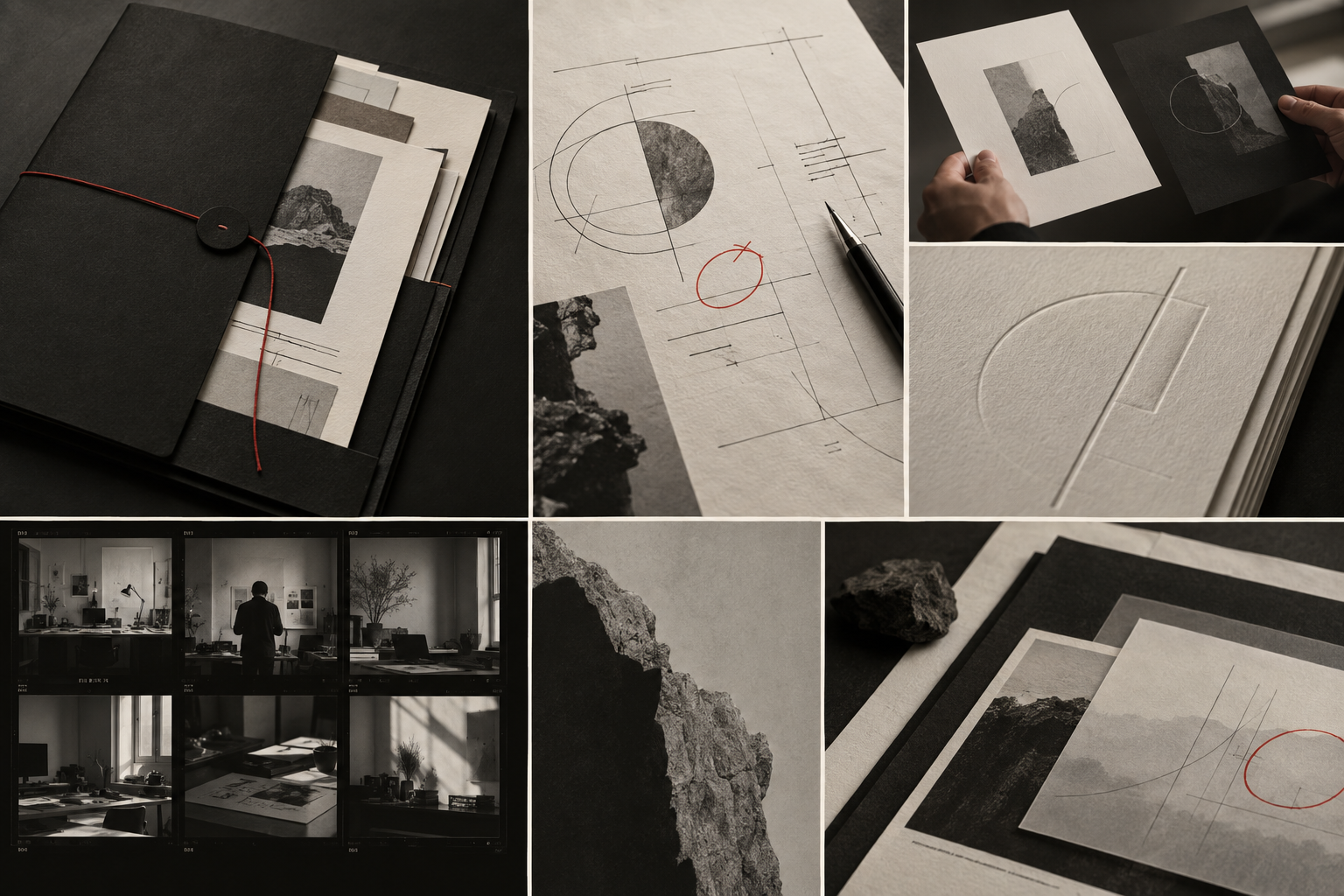
Route B / Editorial Casebook / concept imagery, not a session photograph
Every decision has a legible order: question, evidence, options, recommendation and what happened next. This grammar works on a carousel, site, brief, session note or email without needing an elaborate illustration each time.
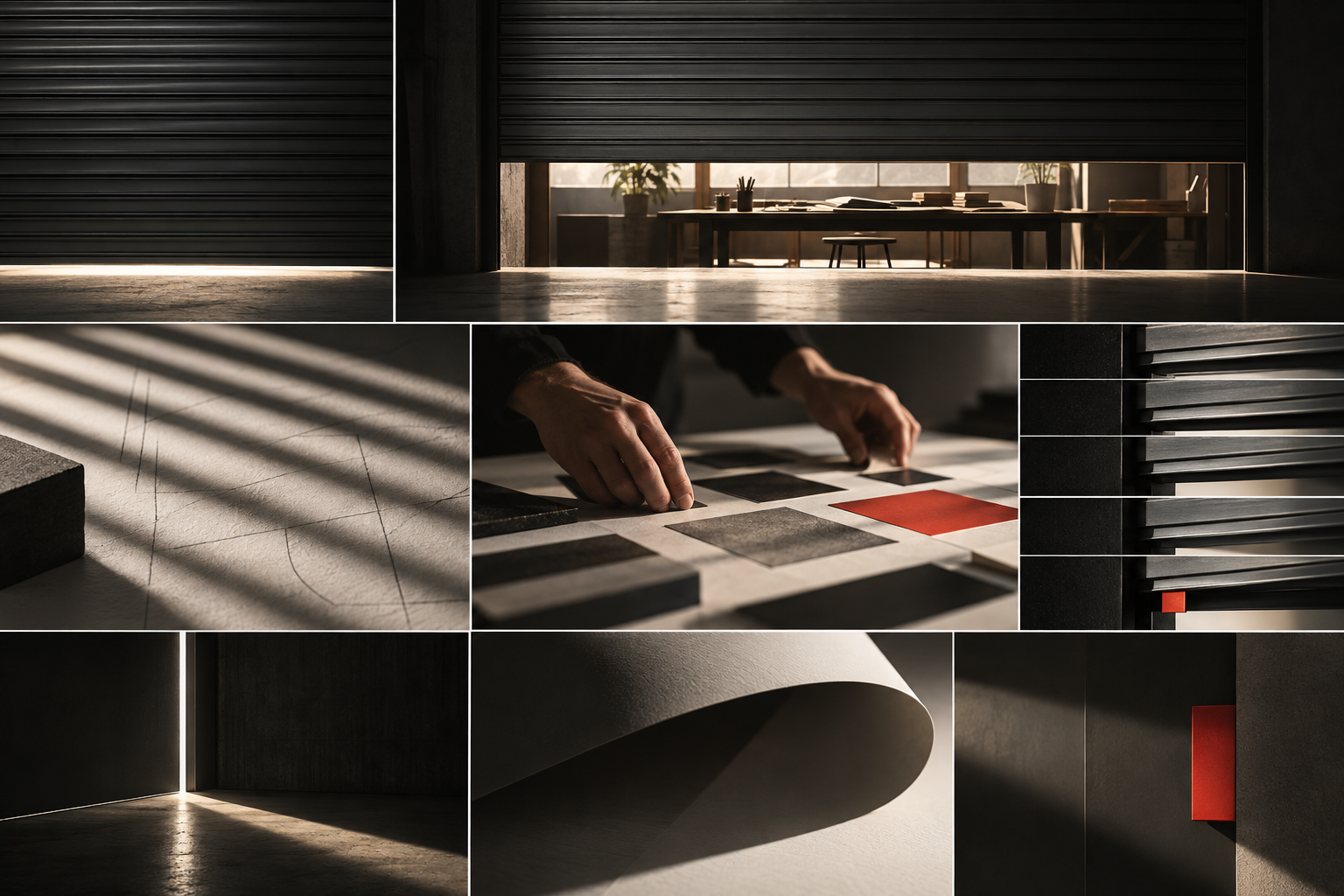
Route C / Shutter Signal / concept imagery, not a real venue
The garage door opens and a decision’s hidden work becomes visible. The shutter is a recognisable reveal for openings and transitions. Light passing through slats can inform photography where the venue and capture plan permit it.

Route A / Workshop Documentary / concept imagery, not event evidence
The room, people and work should look like what happened. Capture hands mid-annotation, a founder listening, boards changing and serious disagreement. Use approved real footage in finished public assets.
Production call: Casebook structures the piece; Shutter supplies a selective opening or transition; Documentary carries approved real evidence. This is a working creative standard. It does not mean every article must contain a photo or every video must open with a literal roller door.
Make the same site hero, social case and video cover in two executions: the chosen synthesis and a simpler control.
Show them to founders, operators and non-attending followers. Ask what Product Garage does, what feels credible and what they remember after a day.
Keep the creative system if it clarifies the offer and strengthens recognition. Change a cue that distracts, looks generic or imposes too much production burden.
A designed cue is not automatically a distinctive asset. It becomes one when it reliably makes people think of Product Garage rather than another brand. Ehrenberg-Bass’s guidance is the standard behind the recognition test.
The specifications here are ready for production, except the vector logo and proposed secondary palette. Designers should follow the rules, test the real fonts and note approved exceptions.
Use Oil and Chalk as the foundation. Signal Red marks a decision, an active point or the proposed logo accent; it does not fill the main button. Graphite #5A564F is secondary type on Chalk. Deep Signal #A82A18 is red small type on Chalk. A lighter red #F07D66 is small accent type on Oil. Never rely on colour alone to label fact, assumption or decision.
Chalk on Oil is about 15.8:1. Signal Red on Oil is about 3.8:1 and on Chalk about 4.2:1, so reserve it for large display or non-text marks. Deep Signal on Chalk is about 6.0:1. Check the actual rendered design against WCAG, including subtitles and photographs.
Oil and Chalk should dominate. Steel, Concrete and Graphite add depth or hierarchy. Red is rare enough to guide attention. Do not enforce a fictional 60/30/10 pixel quota; judge the body of work and the contrast of each use.
Use at 28px and above for headlines, pull quotes and selected numbers. Regular or Medium only. One expressive typographic move per composition. Never use it for forms or long paragraphs.
Use Regular 400 for reading and SemiBold 600 for hierarchy, labels and buttons. Set broad-audience language in full, then abbreviate where the channel warrants it.
| Role | Typeface | Web size | 1080px social guide | Line height |
|---|---|---|---|---|
| Display | Melodrama Medium | 72–160px | 110–140px | 0.9–1.0 |
| Headline | Melodrama Medium | 40–72px | 80–100px | 1.0–1.1 |
| Subhead | Melodrama Regular | 28–36px | 50–58px | 1.1–1.2 |
| Body | Switzer Regular | 17–19px | 34–40px | 1.5–1.65 |
| Caption | Switzer Regular | 14–15px | 28–32px | 1.4–1.5 |
| Label | Switzer SemiBold | 12–14px | 26–30px | 1.3–1.4 |
This page uses hosted font requests with Georgia and Arial fallbacks. The production designer must verify the licensed Melodrama and Switzer font files and weights in final exports; a fallback rendering is not a sign-off.
The intended mark is one simple shape that can evoke a garage and a product. Commission a vector master with horizontal, stacked, symbol, Chalk and Oil versions. Test at 32px and in monochrome. Until approved, use the existing raster only where it remains legible; this book’s typeset name is a stand-in, not the final logo.
Do not stretch, recolour, shadow, crop or place the raster over busy footage. Set clear space and minimum sizes from the approved vector, not from a guess in this book.
Use a 12-column web grid and four columns on mobile, with a reading width around 66–68 characters. Social case cards begin at 1080 × 1350 with a 72px safe inset, then are reflowed for square and vertical formats. Left-align reading copy. Buttons are square or nearly square and at least 44px high.
Use a case tag to label QUESTION, FACT, ASSUMPTION, OPTION, DECISION and FOLLOW-UP. Reserve the red version for the decision. The labels, not red alone, carry meaning.
Show real work in progress: hands making a mark, a founder listening, the board changing. Use warm-neutral grading and honest contrast. Slatted light is a preferred cue where feasible, never a requirement that interrupts the room.
A shutter reveal may open a film or divide sections. Suggested duration: 500–700ms with an ease-out. Type cuts in without bouncing or typewriter effects. Respect reduced-motion settings.
Use clear speech and restrained room sound. Do not make industrial clanks the brand soundtrack. Music must be licensed and leave the reasoning audible. Captions are mandatory for speech-led social edits.
These are art-direction specimens and example copy, not published claims. Replace illustrative problems, dates, names and outcomes with approved event-sheet facts. The typeset name is a stand-in until the vector mark is approved. Each specimen is drawn at its real format, and none uses concept imagery: where a photograph belongs, the frame says so.
Your pricing page is answering a question the buyer hasn't asked yet.
Which assumption would you test first?
One operator, 60 seconds, one trade-off.
Three options survived the room
[First name]
[Last name]
[Role] · [Company, if they agree]
Bring your judgement to a real problem.
You'll read the brief, work with a small team and put your recommendation in front of the decision owner.
Apply for a SeatBring the decision you haven't made yet.
If the question is live and it matters, we'll help you frame it and put it in front of operators who have made similar calls. You keep the decision.
Propose a ChallengeSubject: You're in: Product Garage, [date]
You have a seat.
You're one of [number] operators working on [founders]' problems at [venue] on [date]. The brief arrives five days before. Read it, and bring two questions and one assumption you'd challenge.
Here is exactly what we will and won't film, and how to stay out of frame: [capture notice from the event sheet].
[Name], for the Product Garage team
Should [owner] choose A, B or C to reach [outcome] by [date]?
The belief the room could not verify, and why it matters most.
The strongest case against the recommendation, kept as the room argued it.
Product Garage CommunityAnnouncements
Application rule: a template is approved only when it preserves legibility, correct consent boundaries, the appropriate audience action and the proof status of its content. A visually on-brand false claim is off-brand.
Someone should be able to follow Product Garage for years without applying for a seat and still become a better thinker. Content is a public product, not surplus footage from the flagship.
| Series | The audience gets | Source | Best first format |
|---|---|---|---|
| The Problem | A real decision, constraints and why the obvious answer is not enough | Public research or an approved, anonymised brief | Case carousel or article |
| The Operator’s Take | One experienced viewpoint and a serious trade-off | Operator, founder or co-founder with permission | Short video or written exchange |
| The Open Door | A practical question or tool that is complete without a paid or selective step | The facilitation method and case archive | Teaching post or email |
| From the Room | What was debated, including uncertainty and dissent | Approved footage and public decision record | Clip, recap or documentary edit |
| What Happened Next | Whether advice was used, adapted, rejected or deferred | Thirty-day owner follow-up | Case update |
| Seat Call | A clear invitation when a relevant room is open | Approved event sheet | Recruitment post |
The editorial test: would the target person save, discuss or use this piece even if applications never opened? If not, improve the piece or label it as a recruitment message rather than pretending it is teaching.
Produce one written case or teaching piece and one operator perspective. Adapt each for LinkedIn and Instagram only if the edit genuinely suits the channel. Keep an email edition every other week. Treat other platforms as optional distribution, not separate quotas.
Before committing, assign named hours for research, writing, filming, editing, approvals and publishing. If the four-person volunteer team has fewer than eight reliable hours, make one strong story unit per week the floor. Reduce channels before weakening the thinking.
After four weeks, expand if the team met its floor without crisis, has two weeks of prepared material, can publish within its permission process, and sees target-person response rather than empty reach.
The confirmed direction of two LinkedIn articles a week is still the target. In the pilot, the written story unit is the article, so the pilot delivers one a week, and the second article is the first thing added when the expansion rule is met.
Where the real constraint sits: writing is not it. Marketing and GTM has said it can produce 20 to 30 written pieces a week. The constraint is filming, editing and approvals, so the capacity rule should log those hours separately and scale video only when they hold.
The recommended first channels are LinkedIn and Instagram because they fit the current operator and short-video ambitions. Verify against actual audience data; do not treat them as a founder decision. YouTube long-form becomes a scheduled channel only when there is a repeatable approved-footage pipeline and an editor. X, Threads and Reddit can be genuine participation, not automatic reposting.
Publish the two-unit pilot, interview target people, log hours per asset and examine comprehension, useful replies, saves and subscriber conversion by series.
Keep or cut a format based on usefulness and production cost, not a single viral post.
Build the case, approval and edit templates. Set up an owned email path. Capture one approved case from the room without depending on every session to be filmable.
Add one distribution surface only if an owner can maintain it without lowering the core output standard.
Keep the series and channels that attract relevant people and can be produced sustainably. Decide whether long-form film or more frequent short video deserves the next production investment.
Set the lasting weekly rhythm from measured hours, target-audience response and the next 90-day resource plan.
Always create a private decision record. With permission, derive a public case, short clips, a longer explanation and a follow-up. Not every session will produce every format. The independent teaching and operator series keep the Door open between rooms.
Keep 1M as a long-term reach ambition. It is not a 90-day forecast or a substitute for a useful brand. Measure qualified reach, recall and owned audience growth alongside absolute followers.
A small, candid room cannot be treated as a film set by default. Capture should be planned at brief stage, intelligible to participants and constrained technically as well as legally.
Participation must not secretly require blanket promotional use. People should understand the intended footage, audio, uses, platforms and contact path before they apply or accept a seat. The private decision work comes first.
Document the appropriate lawful basis, notices, choices, retention, access, clip review and response to objections with Irish counsel. A lanyard, sticker or verbal “okay” is a crew signal, not a complete policy.
State what will be recorded, intended public uses, who controls the files, retention, participation choices and how a person can ask a question.
The legal basis and wording are approved before the relevant session, including October if capture is planned there.
Mark camera-safe angles or tables. Keep no-film participation genuinely useful. Label company information as public, anonymisable or restricted. Assign a capture lead who is not facilitating.
Crew can tell whom and what to exclude. A lanyard may help identify a choice, but a different colour remains visible to others and is not anonymity.
Use controlled camera angles, close-ups of approved hands or materials, and separately permissioned interviews. Do not use whole-room audio when it captures people who chose not to be recorded.
If the recording boundary cannot be honoured, stop that recording. Do not solve it in editing after the fact.
The challenge owner reviews company material. Identifiable speakers and quoted people have the necessary permission. Check screens, notes, names, trade secrets and factual context.
Approval is recorded against the exact version. A testimonial permission does not cover every clip of that person.
Restrict raw-file access, follow the stated retention period, keep release records and handle objections or removal requests through the approved process.
There is an owner and a response route, not merely a shared drive full of unreviewed footage.
The Irish Data Protection Commission says identifiable event images are personal data and advises particular care at small events, including written consent or a way to identify consent. Its photography FAQ is not a complete video, audio or confidentiality policy. This chapter is an operating brief, not legal advice.
A premium brand is particularly damaged by overclaiming. Each public assertion should have a known source, permission status and proof tier.
A date, participant count, format or approved output. Confirm it against the event sheet or record before publishing.
A participant or founder reaction with attribution and approval. Praise is testimony, not evidence of downstream impact.
The decision owner adopted, adapted, rejected or deferred advice. Use the follow-up record and permission.
A business or product result with a timeframe and credible attribution. No current public case in this book is placed on this rung.
| Question | Measure | Collection | Frequency |
|---|---|---|---|
| Did the room help? | Brief readiness, founder-rated decision utility, operator preparation and contribution, later owner action | Event sheet, short feedback and 30-day call | Every session |
| Is the Door useful? | Target-person saves, replies, returning viewers, qualified follows and email sign-ups by series | Platform analytics and a simple content ledger | Weekly |
| Does the brand attract the right people? | Suitable operator applications and challenge submissions by source | Form questions, selection rubric and links with consistent source tags | Each application cycle |
| Is it remembered? | Unprompted category description and recognition of cues without the wordmark | Short target-audience interviews | At baseline and after exposure |
| Can the team sustain it? | Hours per story unit, approval lag and publishable output per session | Production log | Weekly for first 90 days |
Set baselines before targets. A 10-person comprehension check is a directional diagnosis, not statistical validation. Record exact responses and objections. A “7 out of 10” result can prompt a rewrite or further test; it cannot certify positioning on its own.
Test a meaningful headline or framing variation with the same audience and distribution conditions. Log the premise, creative versions, result and next decision. Do not promote the founder’s favourite line just because it sounds memorable.
Compare the promise with what founders, operators and public learners actually experience. If the room or editorial output cannot carry the message, improve the experience or narrow the claim before polishing copy.
A brand book is useful only if the event facts, assets, permissions and decisions behind it have owners. This edition can guide work now, but it does not declare open gates closed.
For each event, keep title, date, venue, partner roles, decision owners, challenges, participant count, team structure, application dates, capture notice, named owner and last-checked date. Use it to update the site, Luma, email and posts. The corrected October count is 12, not a permanent brand number.
Record asset ID, file path, source, owner, format, version, rights, people depicted, company-material status, approval, expiry and archive status. Separate AI concepts from real evidence. Retire files into an archive rather than letting an old logo or inaccurate count circulate.
| Decision or asset | Accountable owner | Required check |
|---|---|---|
| Position, idea, identity change | Founder group; Marketing & GTM maintains the book | Decision log and audience evidence where appropriate |
| Challenge and room composition | Named session lead | Acceptance gate and mix review |
| Event facts | Event-sheet owner | All channels match current sheet |
| Public case or outcome claim | Editor + challenge owner + relevant people | Claim rung, fact check and recorded permission |
| Capture process | Marketing lead + capture owner + Irish counsel | Approved notice, audio plan, access and retention |
| Routine social asset | Editor/designer | Voice, identity, accessibility, rights and CTA check |
Choose Route 1 or Route 2 for October (chapter 01), send the notice to all 12 participants, and record the choice in the event sheet. Before November, approve the full notice, lawful basis, participation choices, camera and microphone map, clip approvals, access and retention with Irish counsel.
Commission and test the vector logo. Match the proposed red to the approved master. Verify font files and licences, accessibility, print and small-size use.
Interview suitable founders, operators and non-attending followers. Test descriptor comprehension and chosen visual system against a simpler control. Write the results into the decision log.
Review production and media data weekly, session quality after every room, and strategic positioning monthly during the pilot. Change an element only with a recorded reason, owner and date. Do not redesign because a post underperformed once.
File naming: PG_[asset]_[audience]_[format]_v1.ext. Keep a clear master, export and archive folder. Never use “final_final2”.
Ratification rule: edition 3.1 is the proposed working master. It revises 3.0 without changing its strategy. Once the founders approve it, it can replace the strategy and production guidance in local 1.1 and the reviewed Claude 2.0. It cannot override founder decisions, legal review, an approved event sheet or a future audience finding.
The references informed specific parts of this book. None substitutes for Product Garage’s own briefs, interviews, permissions or outcomes.
The operational forms, interview script and editable registers are in the companion playbook. The working tokens are in brand-system.css. The three moodboards are AI-generated direction only; their original prompt record is here.